
Are you wondering how you can start your own online business?
You’re not alone!
I get questions about building an online business so often, and therefore I decided to create an episode on this topic.
Today, I will share some of the juicy business stuff that will set you and your business up for success from the get-go.
Listen on Apple: https://fastforwardamy.com/apple81
Listen on Spotify: https://fastforwardamy.com/spotify81
Listen on Google: https://fastforwardamy.com/google81
Topics include;
- some of the do’s and don’ts for setting up your first offer,
- how to determine the format,
- which content should go in there,
- and my secrets to selling and delivering your offer to clients.
Let’s dive into the most 5 MOST important steps to build your online business.
1. Brainstorm your first offer with 3 simple questions
The average millionaire has 7 different income streams. Crazy, right?
I’m not saying you need 7 right away or in the future. The most important thing to do when you want to start an online business is that you START.
Once you have one good offer in place, you can build upon that, learn, improve and potentially create even more products or services.
For your first digital or online product, or basically any offer you create, there’s one golden rule you need to follow: never create a product from ego.
To avoid creating from ego, I want you to do an exercise with me. Grab a piece of paper, and draw a Venn diagram (3 circles that overlap in the middle).
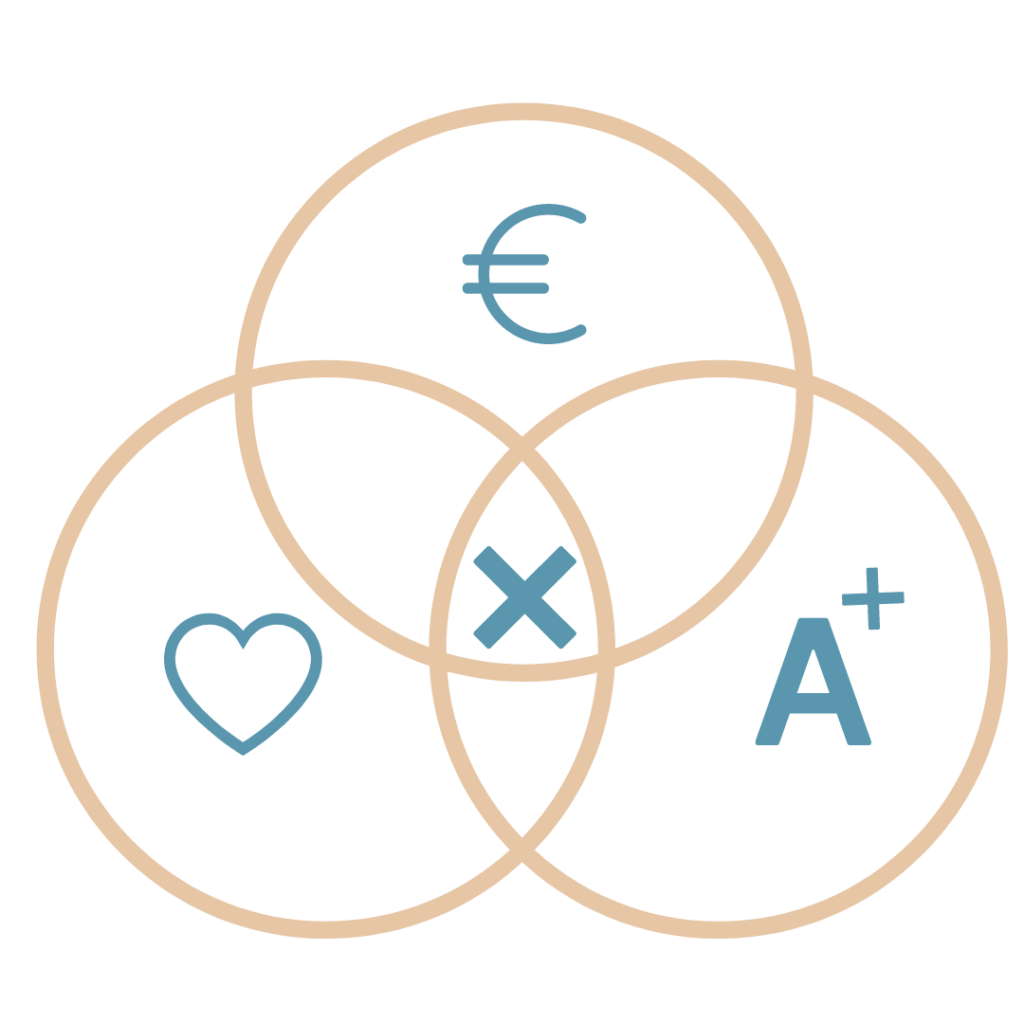
For each circle, you need space to take notes and write down the answer to 3 questions:
Circle #1: What are you good at, and what do you love?
For me, that would be mindset, sales, Instagram marketing, finances, and time management. Now it’s your turn. What are you good at, and what do you love?
Keywords are fine; there’s no need to complicate this.
Circle #2: What do people want and need?
Think about your ideal client and audience. What do they want and need?
For instance, my clients want money. They want to get their time back, they want more sales, and they NEED a good mindset.
Notice how there’s a difference between want vs. need. No one really wants sales skills, but they do want to get more sales.
Therefore, put wants and needs alongside each other in the second circle.
Circle #3: What do people want to pay for?
This one may seem tricky, but let me give you an example. From my experience, people want mindset advice, but they don’t want to pay for it.
If your audience behaves similarly, you can infuse your paid offer with the content customers don’t want to pay for but NEED in order to succeed.
For instance, I could create a sales course infused with mindset principles about selling.
What typically works very well, too, are templates and scripts. Both are very practical, and something people can use right away. Your product has to be easy to work with.
Figure out what your audience wants to pay for and write it down in this circle.
Now you should have the answers to all 3 questions:
- What are you good at, and what do you love?
- What do people want and need?
- What do people want to pay for?
The next step is to find that ONE THING that comes back in all of the circles.
Recap: Before you start creating your offer, use this exercise to brainstorm, talk to people, do a poll in your Instagram stories or talk to existing clients. Ask if they would be interested and if they would pay for it.
2. Craft your offer from one-on-one to standalone
The easiest way to craft your offer, granted you have a service-based business, is to look at what you have done in the past.
For instance, if you have been working one-on-one with people, you already know what they struggle with initially and what the next steps should be.
After you have done a lot of one-on-ones with clients, it will be easier to bring them together in a group and go through the exact same steps.
The experiences you get from one-on-one and group coaching will be extremely valuable and will help you create the standalone digital offer you’ve wanted for a long time.
After you gain this experience, you will know their frequently asked questions, what people tend to bump into, what challenges they face, and so on.
Once you have picked the thing that comes back in all three circles, it may be that you need some more experience before you can create your digital product or online course.
That’s totally fine. Most starting entrepreneurs have to go through this journey; you’re not alone!
3. Decide on the digital format
Alright, you now know what the core of your digital product is going to be about. Next, it’s time to choose your format.
Is it going to be
- A digital video course?
- Video modules with text and assignments?
- An ebook?
- An email course?
Choose what fits your primary topic best.
For instance, for your first online course, create a pop-up Facebook group, and host a 2-day to a week-long course in the group. Go live and re-record the modules from the live course afterward.
Voilà! This is a great way to create some really nice content.
If you think a paid email sequence or an ebook are better options, then go with that.
Whatever format you choose, make sure it’s the absolute BEST format to get your message across.
Also, pay attention to the perceived value of the format you choose. For example, a PDF seems less valuable and is difficult to look expensive compared to a video course.
TIP! Add video to your variety of formats. It will always increase the perceived value of your offer. BUT if video feels like a step too far for you, don’t let it stop you from creating your first offer. Pick your format, and go, go, go.
Maybe you’re also interested in this: How to Use Email Marketing to Grow your Business and Sales
4. Create the content in a happy flow
You have come a long way, and it’s time to look at the actual content of your offer.
Before you do that, I want to share a really important hack with you that I learned while studying IT.
Whether you’re creating an online course or any other digital product, look at the happy flow for your clients.
I know what you’re thinking, “Amy, the happy flow? What’s that?”
Let me tell you: the happy flow for your online product is the standard way you typically walk clients through a coaching or consulting track.
To find this flow, ask yourself: which steps do my ideal clients go through during a one-on-one program?
Use these insights from your standard program when you create the content for your first digital offer.
At a certain point, you will most likely encounter exceptions from this standard way of working, but don’t let those exceptions distract you from the happy flow.
For instance, a fitness coach has a standard program, but suddenly a client is pregnant and can’t follow the normal flow anymore.
Figure out those exceptions later on, and focus on what you know works right now. If you start by trying to solve all the “what ifs”, you’re never going to be able to create that happy flow for your product.
Recap: For your first digital product or online course, stick to one standard structure to start (stick to the happy flow), and structure your offer like you would do with your clients in real-life.
5. Deliver your offer
Delivery of your digital product is everything that happens from the moment people hit the pay-button to the moment they get access to the course.
You can take several delivery routes.
For instance, you can set up a Shopify website that allows people to check out, pay, and get the ebook delivered in their inbox.
Or, if you’re offering an online course, you can set up everything directly in a tool like Teachable, have clients pay in the Teachable system itself, and enroll them automatically or manually.
There are so many ways you can do this.
If you want to know more about the systems I use, make sure to check out the Online Business Systems Bible.
The most important takeaway is this: whatever systems you choose for delivering your product, be it emails, video courses, or real-life coaching, make it really SIMPLE.
Use the KISS principle (Keep It Stupid Simple). It’s crucial for delivering your product, coaching people, getting people to attend a webinar or anything that involves your clients.
Keep It Stupid Simple.
TIP! Make sure you test the flow yourself, pay for your own product, have a friend pay for your product. In short, test it all and ask yourself if it makes sense. The same goes for free offers, like lead magnets and webinars. Always test it!
There’s no perfect blueprint for delivering your product because you will learn along the way, and you’ll adjust and improve based on the feedback from your clients.
Recap: 5 steps to start creating and selling your first digital product!
We’re nearing the end, and that means you’re ready to start working on your first offer. Before you dive in, let’s recap the most important steps.
- Brainstorm your first offer with 3 simple questions: what are you good at and love? What do people want and need? What do people want to pay for?
- Craft your offer from one-on-one to standalone: what content can you reuse from previous one-on-one sessions or group coaching?
- Decide on the digital format: what format fits your primary topic best? An ebook, video course, or email sequence?
- Create the content in a happy flow: focus on the happy flow of your ideal clients, and don’t let exceptions distract you.
- Deliver your offer: Keep It Stupid Simple and test the entire delivery flow before launch.
Good luck!
Watch this episode on YouTube or listen via iTunes, Spotify, or wherever you get your podcasts, and search for episode 81 of The FastForwardAmy Show.
PS Do you want to learn more about going online with your offline business, or about starting a new online business, and how to do it right from the get-go?
Well, then my Design Your Online Business is exactly what you’re looking for!
In this webinar I will tell you how to build your successful online business. Register now for this webinar, which is worth €199 but you’ll get it for FREE, through fastforwardamy.com/designobw.
In this webinar, I’ll talk about:
- How you can build your location-independent online business.
- How you can start building your new online business.
- What the right prices are for your products.
I wouldn’t wait too long because this is a live webinar and there are only 500 seats available! There will be no replay, so if you want to join you can register NOW through fastforwardamy.com/designobw.
We do not take any responsibility for the financial decisions or any other business-related decisions made by listeners/businesses based on our podcast content. Every business has its own specifics, which we cannot take into account in this podcast.

Leave a Reply